
BJJ Instructor Background: What to Look For
How to vet a BJJ instructor: verify black belt and lineage, review competition and teaching history, confirm background checks, and spot red flags.
BJJ Instructor Background: What to Look For
When choosing a Brazilian Jiu-Jitsu (BJJ) instructor, your safety, progress, and the quality of training depend on their credentials and expertise. Here's what to focus on:
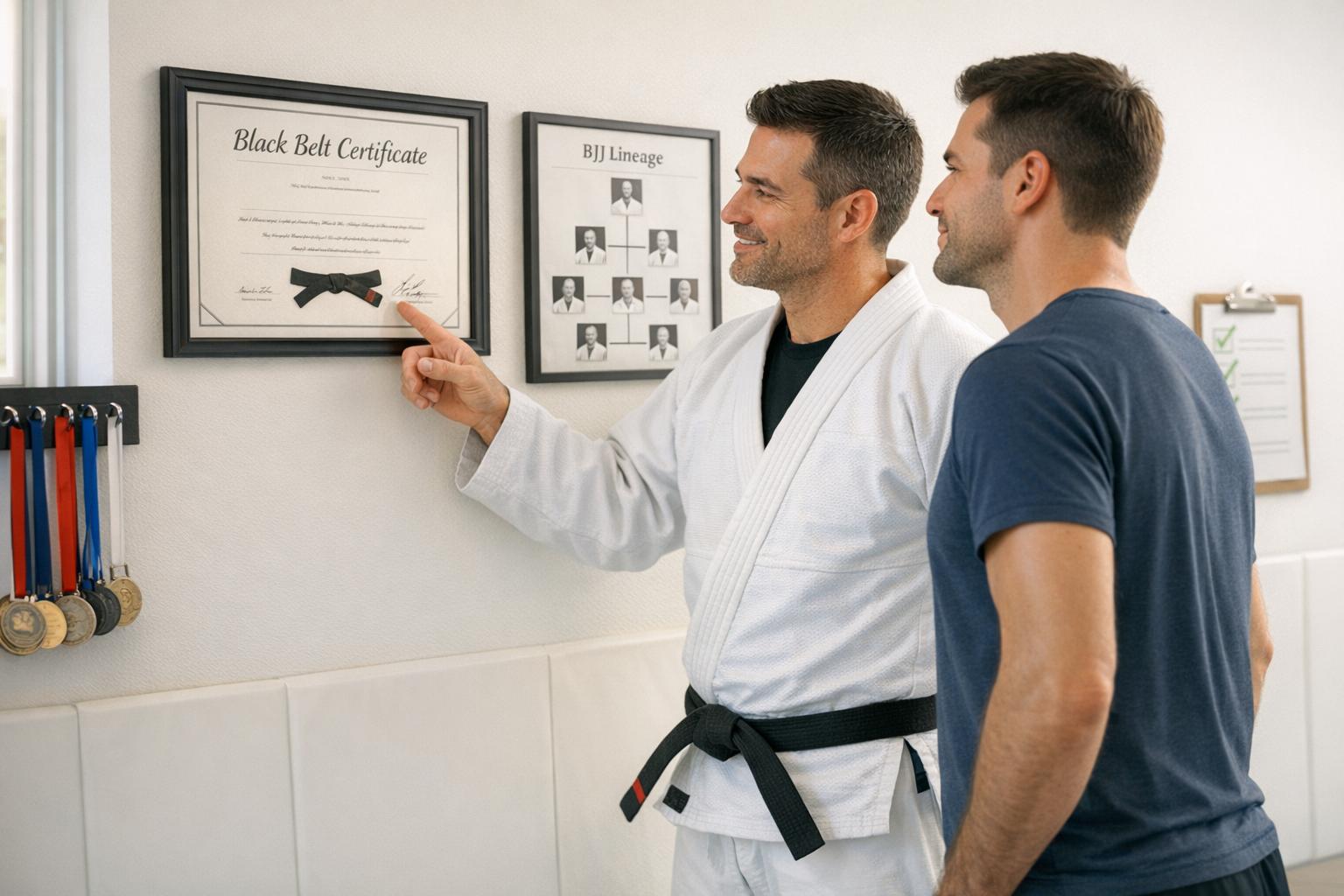
- Verify their rank and lineage: Confirm their black belt certification through trusted organizations like IBJJF or USJJF, or use tools like Beltchecker.com. Ask who awarded their black belt, and ensure their lineage traces back to established figures.
- Check competition history: Look for consistent participation and results in high-level tournaments, especially in adult divisions. Use IBJJF records or tools like BJJ Metrics for verification.
- Evaluate teaching experience: Observe trial classes to see how they teach and interact with students. A strong program produces skilled students at all levels.
- Conduct background checks: Ensure they've passed safety checks, especially in the U.S., where IBJJF requires background screenings for certification.
- Look for red flags: Avoid instructors with unclear lineage, self-awarded ranks, or those who discourage competition or cross-training. Watch out for gyms with unsafe practices or profit-driven policies.
Taking these steps ensures a safer, more effective training experience. Always research, observe, and trust your instincts.
Checklist: Rank and Certification Verification
Black Belt Certification from Recognized Organizations
Start by verifying the instructor's registration in reliable databases like IBJJF or USJJF. For example, the IBJJF charges $400.00 for an initial black belt review, a process that can take up to 30 days to complete.
The IBJJF has specific requirements: instructors must be at least 19 years old, with a minimum of three years per additional degree. Meanwhile, the USJJF sets the minimum age for a 1st Dan at 16 and 30 years old for a 5th Dan. If an instructor's age or promotion timeline doesn’t align with these standards, it’s a potential red flag.
Another useful tool is Beltchecker.com, a free, peer-reviewed database where you can verify credentials. These steps are essential for ensuring the instructor's expertise and trustworthiness.
Belt Promotion Validation
Beyond certification, it’s equally important to validate the instructor's promotion history. A straightforward way to do this is by asking, “Who awarded you your black belt?” A legitimate instructor should have no trouble answering this question. As BJJ Fanatics puts it:
"If an instructor cannot tell you who he or she got their belt from, that is a big red flag. Frauds tend to hide information about their lineage because it [never] simply exists".
Once you have the name of their instructor, verify their lineage through trusted online resources. A credible lineage should trace back to well-known figures like the Gracie family or Luis França. Additionally, if the instructor's academy is registered with the IBJJF, it provides an extra layer of reassurance, as these academies help monitor professors and maintain proper credentials.
Be cautious of instructors who claim self-awarded ranks or boast achievements in multiple obscure martial arts. Such claims often indicate fraudulent behavior and should raise serious concerns.
Checklist: Competition History Assessment
Tournament Participation and Results
A competition history showcases skills tested under pressure. The IBJJF assigns tournaments a "Championship Weight" ranging from 1 to 7, depending on their prestige. For example, the World Championship and World Masters carry the top weight of 7, while regional events like International Opens are weighted at 1. Competing in "Grand Slam" events - such as Worlds, Pans, Europeans, and Brazilian Nationals - means going head-to-head with the sport's elite.
To verify results, you can use the IBJJF website, which provides searchable records of major championships dating back to 1994. For a broader analysis, tools like BJJ Metrics track data on over 200,000 fighters across 1,600 tournaments.
When evaluating competition history, prioritize consistent participation across multiple seasons over a single standout win. The IBJJF weights performances to emphasize recent activity: current season results are multiplied by 3, last season by 2, and two seasons ago by 1. This approach highlights an instructor's current competitiveness and provides insight into their depth of experience.
High-Level Division Experience
The Adult divisions (ages 18–29) are considered the most competitive in Brazilian Jiu-Jitsu. At the black belt level, these divisions often require a minimum number of ranking points just to qualify. As noted by Evolve MMA:
"If you can find instructors that have competed and won at the highest levels, that would be perfect".
While Masters divisions (30+) reflect dedication, success in the Adult divisions is a stronger indicator of exposure to top-tier technical competition. Keep in mind that ranking points are non-transferable between belt ranks and age divisions. For example, achievements as a brown belt don’t necessarily translate to the same level of success at black belt. Always check documented results at the instructor’s current rank to get a clear picture of their competitive standing.
Checklist: Teaching Experience and Lineage
Training History and Lineage Verification
In Brazilian Jiu-Jitsu (BJJ), an instructor's lineage serves as a direct link to the art's origins, tracing their training back to foundational figures like the Gracie family or Luis França. This lineage isn't just about prestige - it ensures the instructor's expertise and the quality of your training. A credible instructor should have no trouble naming who awarded them their black belt. If they hesitate or avoid the question, it's a red flag. As IA Combatives explains:
"If they don't openly talk about where they got their knowledge... BJJ has very narrow roots. Any legitimate instructor should be able to point to their lineage".
Take Gordon Ryan as an example of clear lineage: he earned his black belt from Garry Tonon in 2016. Tonon was promoted by Tom DeBlass, who was promoted by Ricardo Almeida - the first black belt under Renzo Gracie. This kind of verifiable history not only reinforces authenticity but also helps you avoid unqualified instructors.
However, not every lineage ties back to the Gracies. For instance, Julio Cesar Pereira, a 7th-degree black belt from the França lineage, proves that non-Gracie lineages can be just as credible. His students achieved 35 podium finishes at the 2016 World Championship. The key isn't a famous name but a clear, verifiable connection to BJJ's origins. While lineage establishes credibility, an instructor's true value is reflected in their students' growth and accomplishments.
Instructor Experience and Student Success
The real test of an instructor's skill lies in their students' success. As Journey BJJ Academy points out:
"Individual instructor competition history matters less than whether the students are winning".
Look for evidence of student achievements across all belt levels - white, blue, purple, and beyond. A strong program will produce consistent results, not just one standout competitor.
Take advantage of trial classes, which most gyms offer for free. These sessions let you observe if the instructor explains techniques clearly, provides individualized feedback, and actively participates in sparring demonstrations. Pay attention to whether students seem to be improving and engaged in their training.
Additionally, check if the school tracks student progress with formal systems or software. The International Brazilian Jiu-Jitsu Federation (IBJJF) sets minimum time requirements for each belt level - two years at blue belt, 1.5 years at purple belt, and one year at brown belt. Reaching black belt typically takes a decade of consistent training. Be wary of instructors who promote students too quickly or discourage competition altogether, as these could be signs of a weak curriculum.
Checklist: Background Checks and Safety Credentials
Background Check Completion
When it comes to ensuring safety in Brazilian Jiu-Jitsu (BJJ), verifying an instructor's background is a critical step. Since December 2014, the International Brazilian Jiu-Jitsu Federation (IBJJF) has required all U.S. black belt applicants and academy professors to undergo background checks. This policy was introduced after instructor Aldo Batista Dos Santos was convicted on 12 counts of sexual abuse of a minor. It serves as a stark reminder that credentials alone don’t guarantee a safe environment.
To conduct these checks, IBJJF partners with the National Center for Safety Initiatives (NCSI), which processes results within five business days for a fee of $18.50. Certain offenses automatically disqualify an individual, including any sex-related crimes, violent felonies like murder or robbery, and other serious felonies committed within the past 10 years.
You can confirm an instructor's status by checking the IBJJF Registered Academy List or verifying if they hold a current IBJJF Black Belt Certificate. For U.S.-based instructors, this certification is only issued after passing a background check. Additionally, don’t hesitate to ask the instructor directly about their "Green Light" status from NCSI. As the IBJJF emphasizes:
"The background check is one of the important actions taken by USBJJF/IBJJF to increase the safety of BJJ practitioners, academies and tournaments."
Once you’ve confirmed the background check, take the next step by evaluating the instructor’s reputation through references.
References and Professional Background
While background checks are essential, they don’t tell the whole story. To get a clearer picture of an instructor’s character and teaching approach, ask for two or three solid references. A legitimate instructor should have no problem providing these. References can shed light on qualities that background checks can’t, such as their conflict resolution skills, teaching style, and reputation within the BJJ community.
It’s also helpful to speak with current students. Ask them about the training atmosphere, how safety concerns are handled, and whether they’ve noticed any questionable behavior. Additionally, reach out to others in the local BJJ community to get a sense of the instructor’s ethics and standing among their peers.
Be cautious if an instructor becomes defensive when asked for references or discourages you from talking to current students. This could be a red flag worth considering. Safety and transparency should always come first.
sbb-itb-d583f1e
Lineage | Choose Who You Train and Associate Yourself With - Wisely (And Trust!)
Checklist: Red Flags and Verification Methods
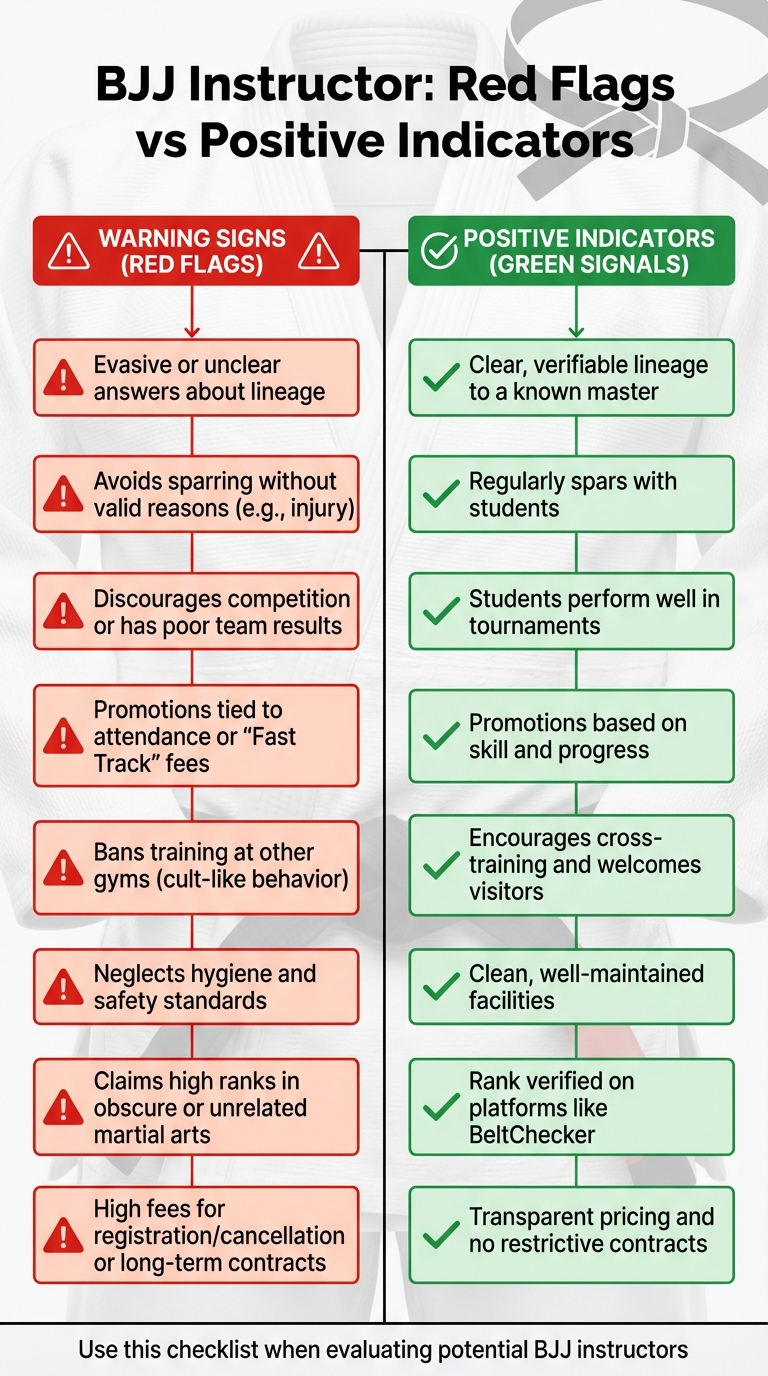
BJJ Instructor Red Flags vs Positive Indicators Comparison Chart
Warning Signs to Watch For
Identifying a fraudulent instructor often comes down to asking the right questions and observing their behavior. Start by asking about their lineage. A credible instructor will answer confidently and without hesitation. As BJJEE puts it:
"If you ask them the simple question 'who did you get your black belt from?' and the answer is unclear or confused then be careful."
Another key indicator is their participation in sparring. A legitimate instructor should regularly spar with students unless they have a documented injury. Struggling with basic techniques, like armbars, or avoiding sparring altogether are major red flags. As BJJ Fanatics explains, fraudulent instructors might focus on collecting fees while neglecting proper instruction.
Be cautious of commercial practices that prioritize profit over genuine teaching. These include "Black Belt Fast Track" programs, charging fees for belt tests or stripes, and contracts with restrictive exit terms. Additionally, instructors who discourage competition or forbid cross-training at other gyms often exhibit cult-like behavior. This could indicate that their techniques wouldn't hold up under scrutiny.
Using Brazilian Jiu-Jitsu Gyms Directory for Verification

Once you've identified potential warning signs, it's time to verify claims through reliable sources. The Brazilian Jiu-Jitsu Gyms Directory (https://bjjacademyfinder.com) is a great tool for this. It provides detailed profiles of academies, including instructor credentials and user reviews, which can help confirm an instructor's lineage and ensure their claims align with what they share in person.
Pay close attention to reviews and ratings on the platform. Look for comments about the training environment, safety standards, and whether the gym encourages competition. If you can't verify the instructor's lineage or credentials through available information, it might be a sign that further investigation is necessary.
Positive Indicators vs. Warning Signs Table
Here’s a quick comparison to help you differentiate between trustworthy instructors and potential frauds:
| Positive Indicator | Warning Sign |
|---|---|
| Clear, verifiable lineage to a known master | Evasive or unclear answers about lineage |
| Regularly spars with students | Avoids sparring without valid reasons (e.g., injury) |
| Students perform well in tournaments | Discourages competition or has poor team results |
| Promotions based on skill and progress | Promotions tied to attendance or "Fast Track" fees |
| Encourages cross-training and welcomes visitors | Bans training at other gyms (cult-like behavior) |
| Clean, well-maintained facilities | Neglects hygiene and safety standards |
| Rank verified on platforms like BeltChecker | Claims high ranks in obscure or unrelated martial arts |
| Transparent pricing and no restrictive contracts | High fees for registration/cancellation or long-term contracts |
This table offers a straightforward way to assess whether an instructor is likely to provide authentic, quality training or if they might be more focused on profit than on teaching.
Conclusion
Picking the right Brazilian Jiu-Jitsu (BJJ) instructor is a decision that deserves thoughtful attention. As BJJEE aptly notes:
"Finding the right Jiu-Jitsu instructor and academy is extremely important. It can make or break your Jiu-Jitsu journey."
An instructor’s knowledge and teaching style play a huge role in your growth, both in terms of technique and overall safety during training. Taking the time to verify their qualifications and approach can save you from wasting time and resources with someone who may not meet your needs.
Start by checking key credentials. Look for black belt certification, competition experience, and their teaching lineage. Remember, a great instructor isn’t necessarily a world champion. Sometimes, an instructor with less fame but a genuine passion for teaching can be the perfect fit. Their students’ progress often speaks volumes about their effectiveness.
Before committing, take advantage of trial classes and resources like the Brazilian Jiu-Jitsu Gyms Directory (https://bjjacademyfinder.com). This platform offers detailed profiles of academies, instructor credentials, and user reviews. You can even filter options by location and training goals, whether you’re focused on competition, self-defense, or fitness.
Most gyms offer free trial classes - usually one or two. Use these sessions to observe how the instructor engages with students, evaluate the cleanliness of the mats, and get a feel for the gym's overall vibe. Trust your instincts, do your research, and choose an instructor who aligns with your goals and supports your journey in Brazilian Jiu-Jitsu.
FAQs
How can I confirm a BJJ instructor's rank and lineage?
To verify a BJJ instructor's rank and lineage, start by asking who awarded their belt. Then, dig into their connection to well-known figures in Brazilian Jiu-Jitsu, like Helio or Carlos Gracie. A genuine lineage will always trace back to the art's founders.
You can also check for official certifications or affiliations with respected academies. Most instructors are open about their background and credentials, so feel free to ask for more details if you’re uncertain.
What warning signs should I look for when choosing a BJJ instructor?
When choosing a Brazilian Jiu-Jitsu (BJJ) instructor, keeping an eye out for potential red flags can save you from a disappointing or even harmful training experience. One key issue to note is if the instructor avoids sparring (commonly called rolling) with students. This could signal a lack of confidence in their abilities or even a gap in their skill set. Another concern is when instructors discourage cross-training or visiting other gyms. This kind of restriction can feel controlling and may hinder your growth as a martial artist.
Unprofessional behavior is another red flag to watch for. For instance, instructors who engage in inappropriate relationships with students or seem distracted - like spending more time on their phone than teaching - show a lack of commitment to their role. If their credentials or lineage are murky or unverifiable, it’s worth questioning their legitimacy as a coach. Finally, be wary of high-pressure sales tactics, such as mandatory long-term contracts or being forced to buy specific gear. These practices often suggest a focus on profits rather than providing quality instruction.
By spotting these warning signs early, you can better ensure that your instructor is skilled, professional, and genuinely invested in your progress and well-being.
Why does an instructor’s competition history matter for my training?
When evaluating a Brazilian Jiu-Jitsu instructor, their competition history can reveal a lot about their expertise and hands-on experience. Success in high-level competitions often reflects not just technical skill, but also a deep understanding of the sport and the ability to execute techniques effectively in high-pressure situations.
If you're planning to step into the competitive arena, learning from an instructor with competition experience can be a game-changer. They bring firsthand knowledge of what it takes to succeed in tournaments, offering practical advice, tailored strategies, and training methods to help you prepare, boost your confidence, and perform at your peak.
Related articles
Share this article