
Ultimate Guide to BJJ Self-Defense Basics
Practical BJJ self-defense: framing against strikes, takedowns, escapes from mount/side control, standing armbar, technical stand-up for real-world safety.
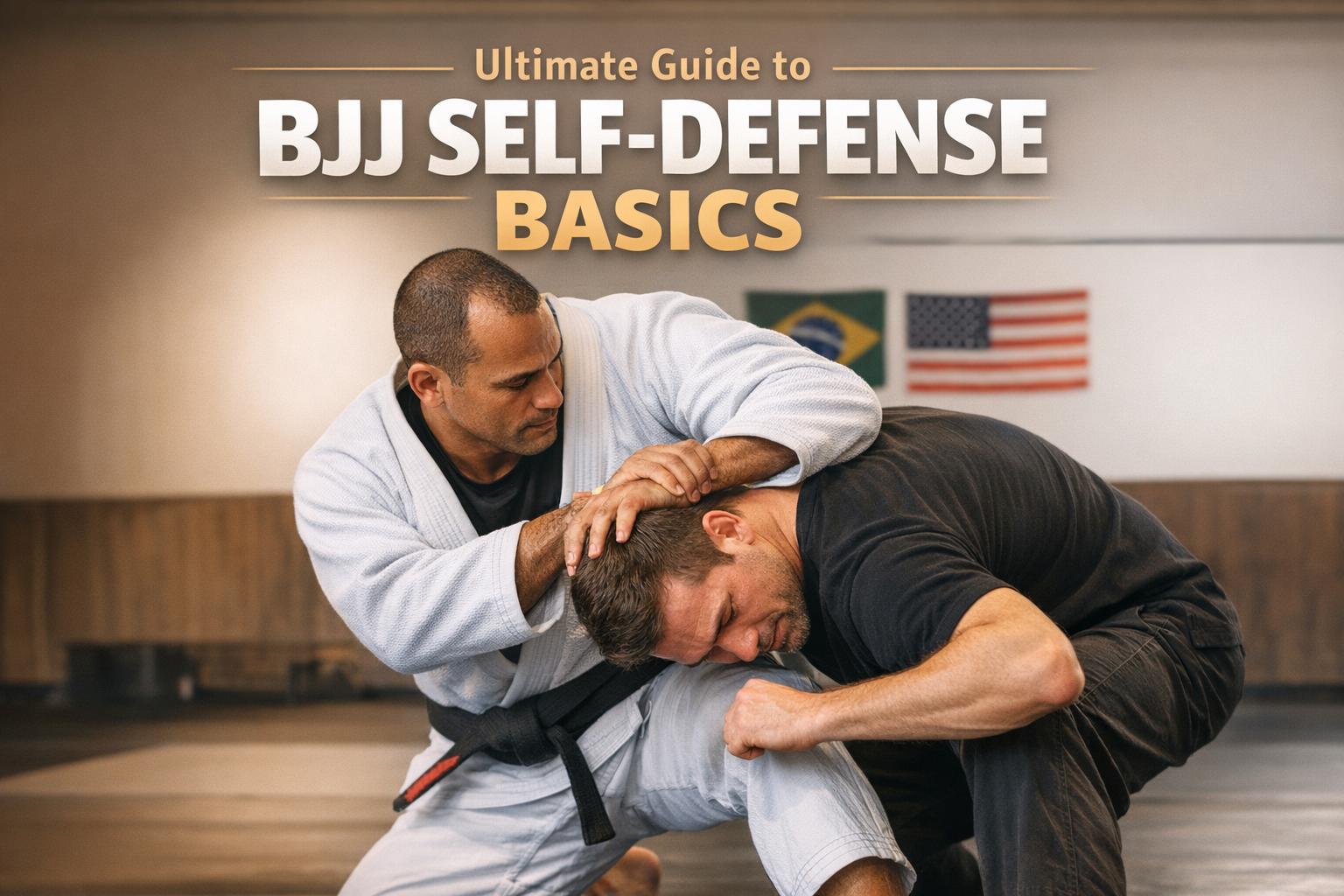
Ultimate Guide to BJJ Self-Defense Basics
Brazilian Jiu-Jitsu (BJJ) is a martial art designed to help anyone, regardless of size or strength, defend themselves effectively. It focuses on ground techniques, using leverage and positioning rather than power. This guide breaks down essential BJJ self-defense moves, including how to defend against punches, escape bad positions, and safely regain control during confrontations. Whether you're new to BJJ or looking to refine your skills, these techniques can help you handle threats with confidence and precision.
Key Takeaways:
- Defend Against Strikes: Use framing to protect yourself and close the gap safely.
- Takedowns: Techniques like Osoto Gari help control the fight by bringing it to the ground.
- Escapes: Learn to free yourself from side control, mount, and headlocks using proper hip movement and leverage.
- Standing Submissions: Moves like the standing armbar offer quick ways to neutralize attackers without going to the ground.
- Getting Back Up: The technical stand-up ensures you can safely return to your feet while staying protected.
Training regularly and finding the right BJJ gym are crucial to mastering these skills. Look for beginner-friendly classes with experienced instructors and a focus on practical self-defense. Consistency is key - just two to three sessions a week can build the muscle memory needed to react instinctively in high-pressure situations.
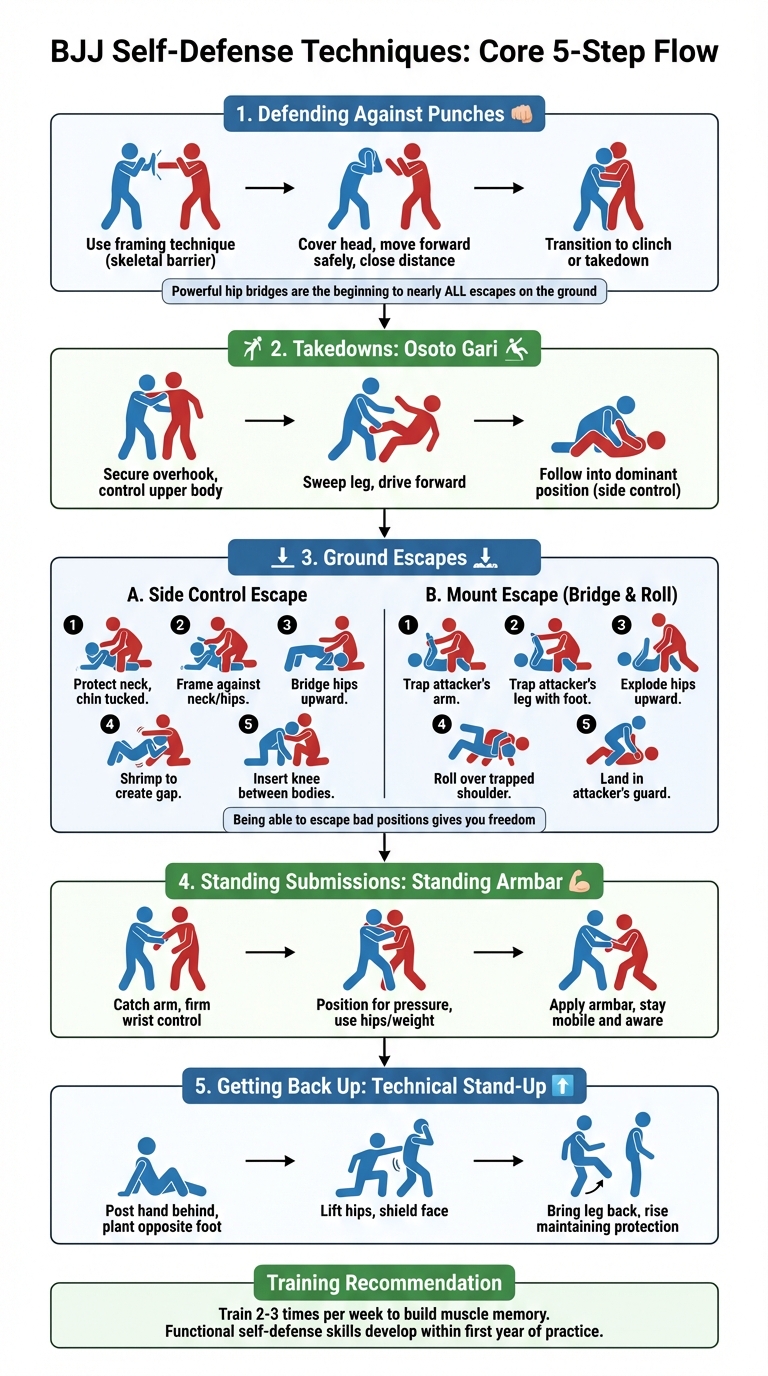
Essential BJJ Self-Defense Techniques: Step-by-Step Guide
x5 Beginner Jiu-Jitsu Techniques for Self-Defense
sbb-itb-d583f1e
Basic BJJ Techniques for Self-Defense
The following techniques are straightforward and practical responses to common threats like punches, takedowns, and arm locks. These moves blend fundamental BJJ positions with effective self-defense strategies.
Defending Against Punches and Closing Distance
Most street confrontations begin with punches, and a single well-placed strike can end a fight before you even get a chance to engage. The goal here is to protect yourself while closing the gap, bringing the fight into a range where BJJ techniques shine. This is where framing becomes essential. Framing uses your forearms and hands to create a strong, skeletal barrier that keeps an attacker at bay. Unlike blocking with brute strength, which can be exhausting, framing relies on bone structure, conserving energy while maintaining defense.
"If you cannot connect with your opponent, you will be unable to grapple with your opponent." - TRITAC Martial Arts
When punches come your way, cover your head and use TRITAC Frames to safely move forward. This approach shields you while allowing you to advance. Keep your body balanced and your posture firm as you close the distance. Once you're close, your opponent's ability to throw powerful strikes diminishes significantly, giving you the opportunity to transition into a clinch or takedown. Techniques like the Osoto Gari can then help you take control on the ground.
| Feature | Framing | Direct Blocking |
|---|---|---|
| Mechanism | Uses skeletal structure as a barrier | Relies on muscle strength to deflect blows |
| Distance | Maintains or creates space | Happens at close range, where impact is greatest |
| Objective | Neutralizes pressure, enabling safe entry into grappling range | Focuses on stopping immediate damage |
| Energy Use | Energy-efficient; leverages positioning | Energy-intensive; requires active resistance |
Osoto Gari Takedown from Overhook
Once you've closed the gap and gained control, the Osoto Gari is a dependable way to take the fight to the ground. This classic Judo throw integrates seamlessly into BJJ self-defense. The setup is simple: secure an overhook on your opponent’s arm to control their upper body and limit their ability to strike or escape. From there, you sweep their leg while driving forward with your weight.
The overhook not only controls their movement but also traps their arm, reducing their ability to retaliate. As they fall, you can follow them down into a dominant position, such as side control or knee-on-belly, where you can maintain control and decide how to end the encounter. This technique relies on timing and positioning rather than raw strength, making it accessible to practitioners of all sizes.
Standing Armbar Submission
In unpredictable situations, staying on your feet is crucial. The standing armbar is an effective way to neutralize an attacker quickly without going to the ground. Borrowed from Japanese Jujitsu, this move hyperextends the attacker’s elbow, forcing them to submit or rendering their arm ineffective.
The technique often begins when an attacker grabs you or throws a punch. You catch their arm, control their wrist, and position your body to apply pressure to the elbow joint. The key is maintaining a firm grip on their wrist while using your hips and body weight to generate leverage. In training, pressure is applied gradually, but in real scenarios, this move can instantly stop an attack. Staying upright during this submission keeps you mobile and aware of your surroundings - an important advantage in chaotic situations.
"Mastering basic techniques increases the effectiveness of self-defense scenarios... [giving] beginners the confidence and ability to defend themselves in real-life situations." - Worcester Martial Arts Academy
Escaping from Ground Positions
When you're pinned on the ground, you're in a dangerous spot - your attacker has the upper hand, and you're vulnerable to strikes. The key to survival? Create space, move your hips, and get back on your feet as fast as possible. These escapes aren't about brute strength; they're about technique and leverage, making them effective even against bigger, stronger opponents. They also reflect the core principles of Brazilian Jiu-Jitsu (BJJ), helping you recover from tough situations.
Escaping Side Control with Hip Movement
Side control is a tough position to escape. In this pin, the attacker sprawls across your chest, controlling your upper body while you're flat on your back. Mobility is limited, and you're exposed to strikes. Your first move? Protect your neck - keep your chin tucked and your hands ready to block chokes or punches.
The escape starts with framing and hip movement, not muscle power. Use one hand to block the attacker's crossface by cupping their bicep or tricep. This prevents them from pressing their shoulder into your face. Then, use your forearms as frames against their neck or hips to create a barrier. The goal is to maintain space without tiring yourself out.
Next comes the bridge and shrimp combo. Start by bridging your hips upward to off-balance the attacker. Immediately follow with a shrimp (a hip escape) to create a gap. Once there's space, wedge your knee between you and the attacker. Driving your knee toward their shoulder can make it harder for them to regain control. Another option is the Ghost Escape, a scissor-like motion that transitions you to a safer position. If the attacker applies heavy shoulder pressure, you can also turn to your knees - this "back door escape" helps you work toward their legs.
Mount Escape Using Bridge and Roll
The mount is an even worse position. Here, the attacker sits on your chest with their knees pinning your arms, leaving you very exposed to strikes and other attacks. The bridge and roll, also called the "Upa", is one of the most reliable ways to escape. It uses your strongest muscles - your thighs, hamstrings, and lower back - to flip the attacker off you.
To start, trap their limbs on one side. Use one hand to grab their triceps and the other to secure their wrist, pinning their arm against your chest. At the same time, trap their leg by placing your foot outside their corresponding foot. With their arm and leg immobilized, their ability to stabilize is severely limited.
Now, explode your hips upward and roll over the shoulder on the trapped side. This momentum flips the attacker, landing you inside their guard. From there, you can either stand up or break away. As BJJ black belt Stephan Kesting emphasizes:
"Powerful hip bridges are the beginning to nearly ALL escapes on the ground."
Avoid trying to push the attacker off with your arms - it wastes energy and can leave you open to submissions.
Standing Up from the Ground Safely
Once you've escaped, getting back on your feet is crucial. The Technical Stand-Up is the safest way to do this while keeping yourself protected. It lets you maintain distance and avoid exposing your back to the attacker.
From a seated position, post one hand behind you and plant the opposite foot flat on the ground. Keep your free hand up to shield your face. Lift your hips, then bring your grounded leg back in line with your posted hand as you rise to your feet. As Evolve MMA explains:
"The technical stand-up teaches you how to safely get back on your feet without exposing yourself to strikes or leaving your body vulnerable."
This method allows you to disengage safely. Kenneth Brown, a BJJ black belt, puts it simply:
"Being able to escape bad positions gives you freedom."
Defending Against Common Attacks
Escaping Headlocks Standing and on the Ground
Escaping a headlock, whether standing or on the ground, relies on the same core principles of Brazilian Jiu-Jitsu: efficient movement, framing, and hip control.
The headlock is one of the most typical attacks in real-world confrontations. It gives the attacker a false sense of dominance, as they may believe controlling your head means controlling the fight. As BJJ Fanatics puts it:
"The head is easy to get a hold of, and by controlling someone else's neck, you can control the direction they go. Thus, the illusion of controlling the flow of the fight."
While they may control your head, your body remains free to act. In a standing headlock, your arms and legs are your tools. Use them to disrupt their grip and shift your balance. If you're pressed against a wall, employ pummeling techniques to reverse their hold and regain control.
On the ground, the same principles apply but require slight adjustments. Use your forearms to frame and create space, while shrimping to reposition your body. If the attacker is on top, a bridge and roll can reverse the situation. Once you've freed yourself, a technical stand-up ensures you get back to a safe standing position. These techniques flow naturally into other ground-defense strategies, keeping you in control.
The key takeaway? The attacker’s focus on your head leaves the rest of your body free to counter. This shift in mindset - from panic to strategic movement - is what makes Brazilian Jiu-Jitsu such a powerful tool for self-defense.
Finding a BJJ Gym for Self-Defense Training
Once you've grasped the techniques, the next step is finding the right gym to train. Brazilian Jiu-Jitsu gyms often have different focuses - some lean toward sport competition, while others are rooted in practical self-defense. If you're aiming to protect yourself against real-world threats like headlocks or surprise attacks, look for a gym that prioritizes self-defense techniques over competition-specific moves like berimbolos and lapel guards. Choosing the right gym ensures you build on the self-defense skills you've already learned.
Start by researching the instructors' credentials and confirming the gym offers beginner-friendly classes. A qualified black belt typically has over 10 years of experience and is often connected to reputable organizations like the IBJJF. Look for programs labeled "Fundamentals", "Intro", or "BJJ 101", which focus on foundational movements like shrimping and bridging before progressing to advanced sparring. For a detailed look at gym options, check out the Brazilian Jiu-Jitsu Gyms Directory (https://bjjacademyfinder.com), which provides information on programs, instructor backgrounds, and user reviews for gyms across the U.S..
Location plays a big role in staying consistent with training. Choose a gym that's within 15–20 minutes of your home or workplace, as most practitioners train 2–3 times a week. When attending a trial class, pay attention to the atmosphere. A supportive and welcoming environment is crucial. As Lake Effect Martial Arts explains:
"Proximity is key to consistency. Battling traffic and long commutes to the gym will wear on you and create friction to attending."
A gym with members across a range of skill levels and belt colors often reflects a professional and inclusive culture.
Expect monthly membership fees to range from $100 to $250, depending on the gym's location and reputation. Additionally, you'll need an initial investment of $100 to $200 for gear like a Gi, rash guard, and shorts. Use your free trial class to evaluate the gym's cleanliness, the teaching style, and whether the curriculum emphasizes self-defense. Be sure to ask about cancellation policies and avoid signing long-term contracts until you're confident the gym aligns with your goals.
The right gym will do more than just teach techniques - it will build your confidence to handle real-world situations. As Carlos Daniel, Head Professor at Gracie Barra Salt Lake City, puts it:
"Self-defense is not about being aggressive. It's about being capable. It's about knowing you have options if something goes wrong."
Conclusion
Brazilian Jiu-Jitsu equips you with practical tools to handle real-life threats effectively. The techniques highlighted in this guide - like defending against punches, escaping headlocks, and safely standing up - are designed to work regardless of size or strength. It's all about using leverage and precision, not raw power. As Helio Gracie once said:
"Very strong opponents might continue to fight even with a broken arm, so [I] preferred the choke as [my] favorite submission"
This philosophy shifts the focus of self-defense from brute strength to skillful execution.
Consistency is your best ally. Training two to three times a week builds the muscle memory necessary to respond instinctively under stress. While earning a black belt can take 8–12 years, you’ll start developing functional self-defense skills within your first year of dedicated practice. The secret? Show up regularly and drill the basics until they become second nature.
Finding the right academy can make all the difference in your training journey. Look for schools that emphasize structured fundamentals, have experienced instructors with verifiable credentials, and foster a welcoming environment where beginners can learn comfortably. A clean, well-maintained facility with strong hygiene practices is essential, and choosing a location close to home or work helps you stay consistent. The Brazilian Jiu-Jitsu Gyms Directory (https://bjjacademyfinder.com) is a useful resource, offering details on programs, instructor backgrounds, and student reviews to help you compare options across the U.S.
At its core, self-defense is about building both capability and confidence. These techniques provide clear, actionable options when faced with danger. As the old Brazilian Jiu-Jitsu saying goes:
"It's not about how good you are, but how good you're going to be if you don't quit"
Stick with your training, trust the process, and watch your skills grow.
FAQs
Why is framing more effective than blocking in BJJ self-defense?
Framing in Brazilian Jiu-Jitsu (BJJ) self-defense works better than direct blocking because it builds a structured barrier using your arms or hands. This method isn’t just about stopping an attack - it’s about controlling your opponent’s movement, keeping them at a safe distance, and opening up chances to escape or counter.
Unlike blocking, which depends on directly stopping force, framing lets you shift your opponent’s balance and movement without relying on raw strength. It gives you better leverage, makes your defense more efficient, and creates smooth transitions into offensive techniques. These advantages highlight why framing is such an essential tool for staying safe and in control during real-life self-defense scenarios.
What should beginners look for when choosing a BJJ gym for self-defense?
When picking a Brazilian Jiu-Jitsu (BJJ) gym for self-defense, beginners should focus on a few important factors to find the best fit. Start with the instructor’s credentials and teaching style. Look for someone with solid experience in self-defense techniques who can clearly explain and demonstrate concepts to beginners.
The gym’s training philosophy matters, too. Choose a place that prioritizes practical, real-world self-defense skills and includes sparring with resisting partners. This approach helps prepare you for real-life situations.
Don’t overlook the environment and culture. A friendly, respectful atmosphere with supportive teammates can make a huge difference in your overall experience. On the practical side, factors like location, class schedules, and costs are key to making regular training realistic.
To make the right choice, visit the gym, watch a class, and talk to the instructors. This hands-on approach can help you decide if the gym aligns with your self-defense goals and personal needs.
Why is it important to stay consistent in Brazilian Jiu-Jitsu training for self-defense?
Consistency in Brazilian Jiu-Jitsu (BJJ) training plays a crucial role in mastering the skills necessary for effective self-defense. By practicing regularly, you sharpen your techniques, refine body control, and develop the muscle memory needed to respond swiftly and confidently in real-life situations.
Sticking to a consistent training routine doesn’t just improve your physical abilities - it also builds mental toughness. This blend of physical and mental preparation is what helps you stay composed and make clear-headed decisions under pressure, which can be a game-changer in self-defense scenarios.
Related articles
Share this article